Melanotan: What the Research Shows
Melanotan refers to two lab-made versions of the hormone that drives skin pigment. Melanotan I became afamelanotide, the only approved alpha-MSH analogue; Melanotan II was never approved, and its human evidence is a few small studies plus case reports of mole changes and serious adverse events.
01 — What melanotan is
Melanotan is the name for two synthetic analogues of alpha-melanocyte-stimulating hormone (alpha-MSH), the hormone that signals skin cells to make pigment. Melanotan I and Melanotan II were developed in University of Arizona research, and each has its own REGEN library page with evidence grades: Melanotan II and Melanotan I.
The two have very different status. A 2017 dermatology review describes afamelanotide, the compound that grew out of Melanotan I, as the only alpha-MSH analogue approved for use in a limited number of medical indications. Melanotan II has never been approved. The same review describes unregulated use of untested melanotan I and II, mainly for tanning, as appearing to have increased.
02 — Melanotan I and afamelanotide research
An early study of Melanotan I in three male volunteers found significant tanning of the forehead, arms and neck after subcutaneous or intravenous injections. The tan was strongest about a week after the injections ended and was still visible three weeks later. No drug was detected in blood when it was taken by mouth, and side effects were occasional stomach upset and facial flushing.
Afamelanotide was later tested as a long-acting implant in erythropoietic protoporphyria (EPP), a rare condition in which sunlight causes severe skin pain. In two placebo-controlled studies of 74 patients in Europe and 94 in the US, people on afamelanotide had more pain-free time in direct sunlight than people on placebo, and adverse events were mostly mild. Both studies were funded by the manufacturer. These results apply to people with EPP, not to cosmetic tanning.
03 — Melanotan II research in men
Melanotan II is a cyclic peptide that acts on several melanocortin receptors, not only the one in pigment cells. In a small pilot study of 3 healthy men, two developed increased pigmentation, measured by skin reflectance, of the face, upper body and buttocks. The men also reported mild nausea, a stretching and yawning complex, and spontaneous erections lasting hours, and one had somnolence and fatigue.
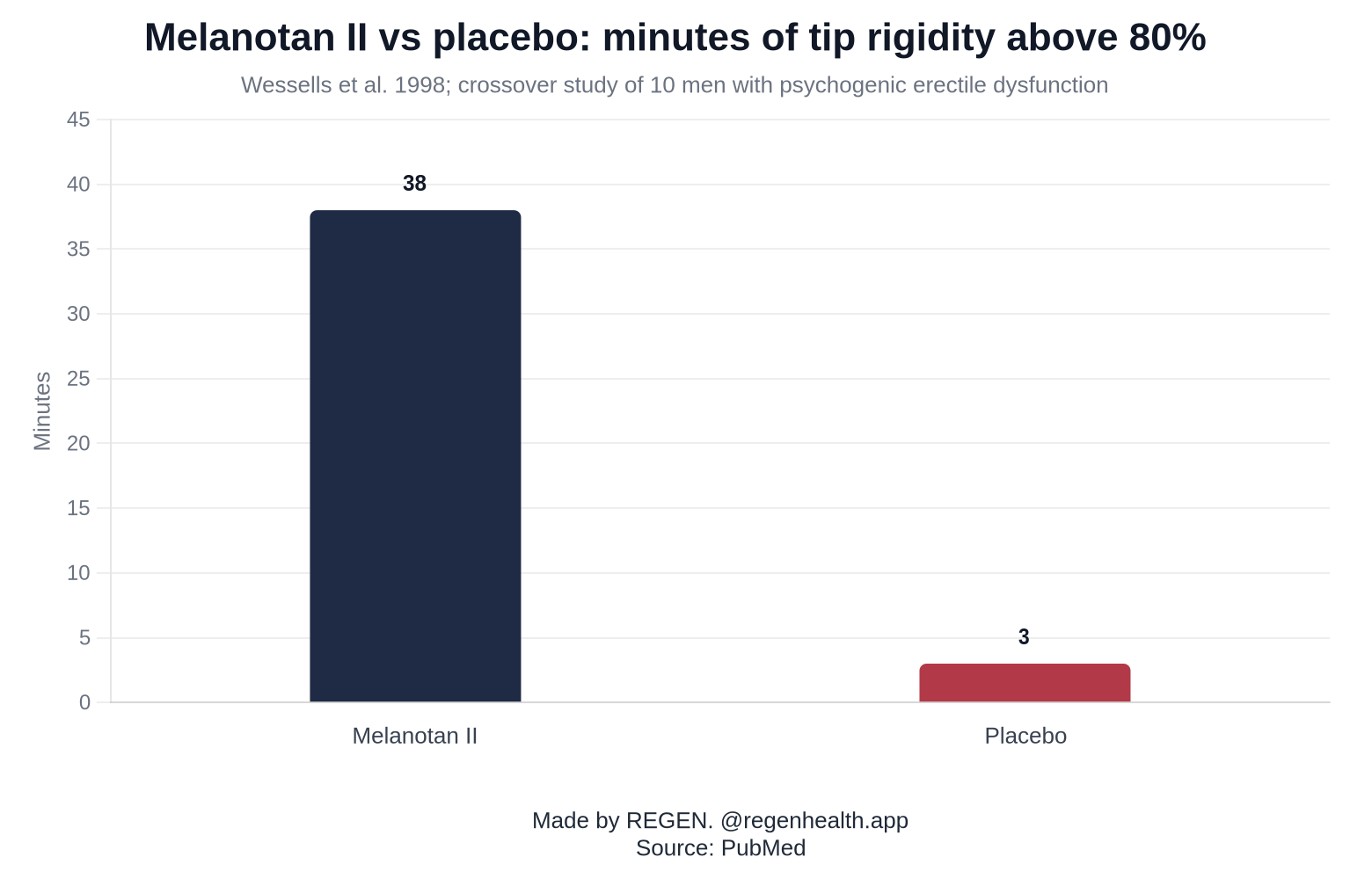
That erection effect led to a separate placebo-controlled crossover study of 10 men with psychogenic erectile dysfunction. Melanotan II produced erections in 8 of the 10 men, and the average time with tip rigidity above 80% was 38.0 minutes on Melanotan II versus 3.0 minutes on placebo. Nausea and stretching or yawning were the main side effects. A related compound, bremelanotide, was later developed for sexual function; our PT-141 vs Melanotan II guide covers how the two differ.
04 — Moles, nevi and melanoma reports
The main dermatology concern is what melanotan does to moles. The 2017 review found growing numbers of case reports linking unregulated melanotan I and II use to changes in existing moles and newly emerging, sometimes dysplastic, nevi. Four case reports described melanomas arising from existing moles during or shortly after melanotan use.
One of those reports describes a 20-year-old woman who was diagnosed with melanoma three months after a three-to-four-week course of Melanotan II self-injections combined with sunbed tanning. Case reports cannot show that melanotan caused a melanoma, and the review states that conclusive evidence linking the two is lacking. It also notes that multiple national health organizations have issued safety warnings about melanotan I and II.
05 — Serious adverse event case reports
Emergency case reports describe rarer but serious problems after unlicensed Melanotan II injections. A poison center report describes a 39-year-old man who developed a racing heart, sweating, muscle tremors, rhabdomyolysis and kidney dysfunction within hours of an injection. His creatine kinase, a blood test marker of muscle damage, reached 17,773 IU/L, and lab testing confirmed the product was Melanotan II.
A 2020 case report and literature review describes a renal infarction, a loss of blood flow to part of a kidney, that the authors judged most likely caused by Melanotan II, and notes earlier reports of rhabdomyolysis and renal failure. A 2019 report describes low-flow priapism after a melanotan injection that needed emergency treatment, with erectile function not yet recovered four weeks later. Each is a single case, so none of them shows how often these events happen.
06 — What unlicensed products contain
Because Melanotan II is unlicensed, nothing guarantees what an unlicensed product contains. A 2015 laboratory study analyzed Melanotan II products bought from three online shops that each claimed 10 mg per container. The containers held between 4.32 and 8.84 mg, and products from two of the shops contained unknown impurities of 4.1 to 5.9%.
The authors concluded that people using these products may be exposed to a range of potential harms, since they are made and supplied through an illicit market. That uncertainty sits on top of the limited human research above: a handful of small studies of Melanotan II, and approved use of afamelanotide only for a narrow medical condition. See how REGEN weighs this kind of evidence on our how we grade page.
FAQ
What is melanotan?
Melanotan is the name for two synthetic analogues of alpha-melanocyte-stimulating hormone, Melanotan I and Melanotan II. Both stimulate skin pigmentation. Melanotan I led to afamelanotide, an approved medicine for a rare light-sensitivity condition; Melanotan II has never been approved.
What is the difference between Melanotan I and Melanotan II?
Melanotan I is the compound behind afamelanotide, the only approved alpha-MSH analogue. Melanotan II is a cyclic peptide that acts on several melanocortin receptors, and in small studies it caused spontaneous erections, nausea and yawning as well as tanning.
What are the side effects of melanotan?
In small human studies, reported effects included nausea, stretching and yawning, spontaneous erections, fatigue, stomach upset and facial flushing. Case reports of unlicensed use also describe mole changes, rhabdomyolysis, kidney injury and priapism.
Does melanotan cause melanoma?
That has not been shown. A 2017 review found four case reports of melanoma arising during or shortly after melanotan use, plus reports of changing and new moles, but stated that conclusive evidence linking them is lacking.
Is melanotan approved?
Only afamelanotide, developed from Melanotan I, is approved, and only for a limited number of medical indications such as erythropoietic protoporphyria. Melanotan II is unlicensed, and several national health organizations have issued safety warnings about melanotan I and II.