Shotsy App: What to Look For in a GLP-1 Tracker
People searching for the Shotsy app are usually comparing GLP-1 trackers. Published studies of other health apps show three practical filters: cited claims, clear privacy and data-sharing practices, and readable number displays.
01 - Evaluating digital health app claims
Evaluating health software starts with whether clinical claims are backed by peer-reviewed literature. In an evaluation of 73 top-ranking consumer mental health apps, 64% claimed effectiveness at diagnosing a condition or improving symptoms, mood or self-management; scientific language appeared in 44% of descriptions, and only one app included a citation to published literature.
Those findings are about mental-health app store listings, not about Shotsy or REGEN. The same checklist still applies when someone is logging a GLP-1 such as Semaglutide: look for checkable sources rather than unbacked efficacy language. Related compound pages in the REGEN Library grade evidence by study design.
02 - Privacy risks in medication trackers
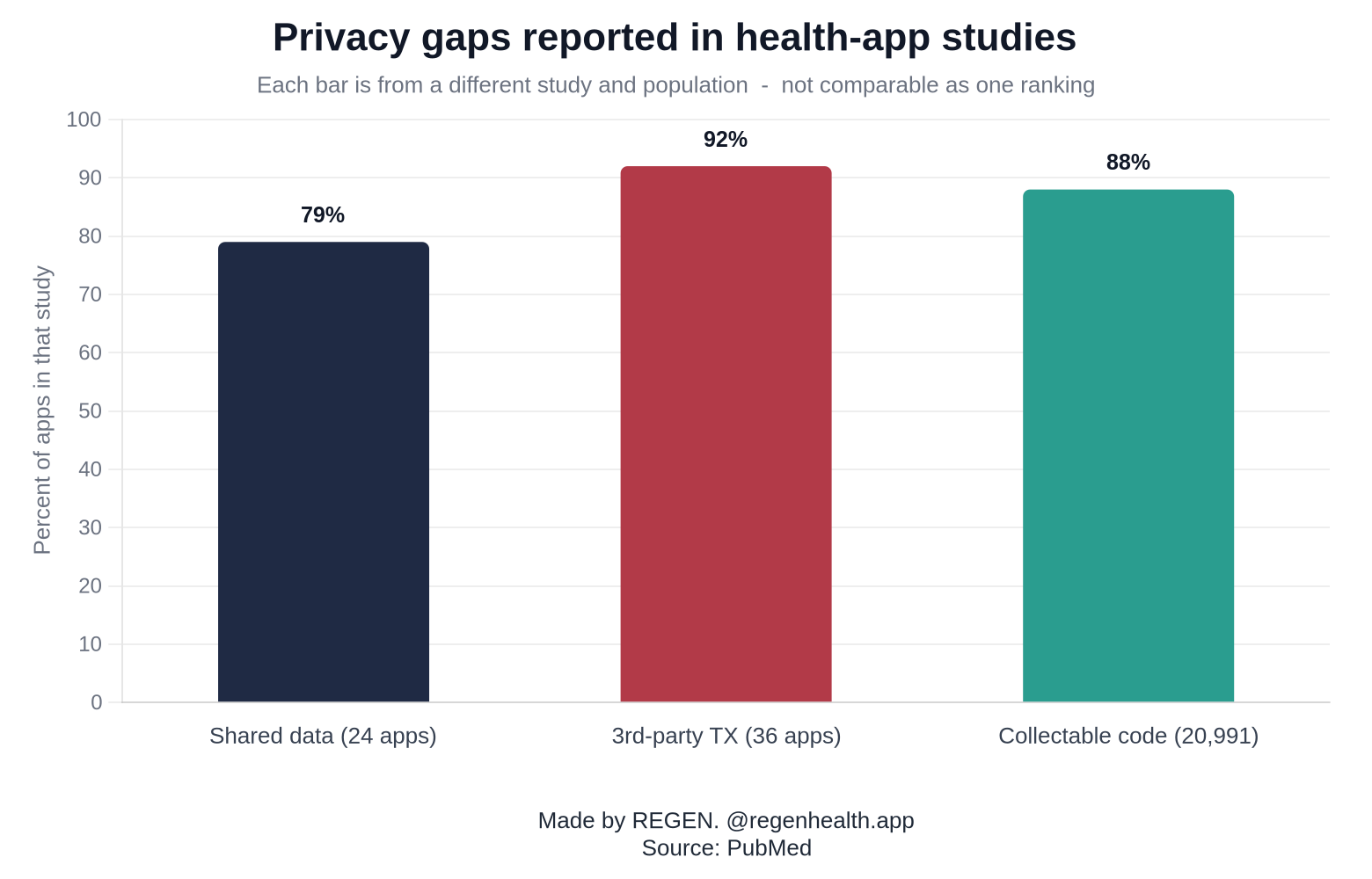
Selecting a medication tracker also means checking how personal data is shared. In an analysis of 24 top-rated medicines-related Android apps, 19 (79%) shared user data; 55 unique entities received or processed that data, and 37 (67%) provided services related to collection and analysis such as analytics or advertising.
That traffic study covered medicines-related Android apps generally. It does not measure Shotsy or REGEN; it shows why a privacy policy and a clear list of third-party recipients matter before you store injection dates in any tracker.
03 - Data transmission to third parties
A cross-sectional study of 36 top-ranked apps for depression and smoking cessation found that 25 (69%) had a privacy policy, while data transmission to third parties was detected in 33 of 36 apps (92%). Twenty-nine of 36 (81%) sent data to Google or Facebook for advertising, marketing or analytics.
Those apps were chosen for depression and smoking cessation rankings, not for GLP-1 tracking. The pattern still flags a practical question for any health logger: where does traffic go once a dose is recorded.
04 - Privacy policies in mobile health tools
In a cross-sectional study of 20,991 mHealth apps on Google Play, 88.0% included code that could potentially collect user data, 3.9% transmitted user information in their traffic, and 28.1% provided no privacy policy.
Missing documentation does not prove misuse, but it removes a checkable promise. For peptide and GLP-1 trackers, a readable privacy policy and an explicit third-party list are baseline filters before comparing feature lists.
05 - Readable displays for tracked numbers
How numbers are shown changes how people read them. In an online experiment with 1620 adults, showing hypothetical lab results as number lines instead of tables reduced perceived urgency for near-normal results without changing perceptions of extreme values; gradient displays gave the greatest sensitivity to changes in results.
That experiment used hypothetical lab results, not GLP-1 dose logs. The design lesson still applies to any tracker that surfaces trends: a clear scale beats a raw table when the goal is to see whether a value is near normal or extreme.
06 - What to check before you rely on a tracker
Put together, the published evidence on other health apps points to three checks before trusting any GLP-1 or peptide tracker: whether claims cite literature you can open, whether privacy policy and traffic destinations are explicit, and whether tracked numbers are displayed in a way that makes near-normal versus extreme values obvious.
REGEN describes dose logging and check-ins on one timeline, REGEN Library pages with evidence grades (including Semaglutide), and Regen AI answers with cited sources - one cited source instead of forty tabs. Our how we grade page explains how those grades are set. The studies above are about other apps, not about REGEN.
FAQ
What do studies suggest checking in a GLP-1 tracker?
Published studies of other health apps highlight three filters: claims that cite literature, an explicit privacy policy and third-party list, and displays that make near-normal versus extreme values easy to read.
Do health apps share user data?
In a BMJ traffic analysis of 24 medicines-related Android apps, 79% shared user data. In a study of 36 depression and smoking apps, 92% transmitted data to third parties.
How common are privacy policies in mHealth apps?
In a study of 20,991 Google Play mHealth apps, 28.1% provided no privacy policy, and 88.0% included code that could potentially collect user data.
Why does display format matter in a tracker?
In an experiment with 1620 adults, number-line and gradient displays of hypothetical lab results helped people judge near-normal versus extreme values better than tables.