Ozempic Side Effects: What the Trials Show
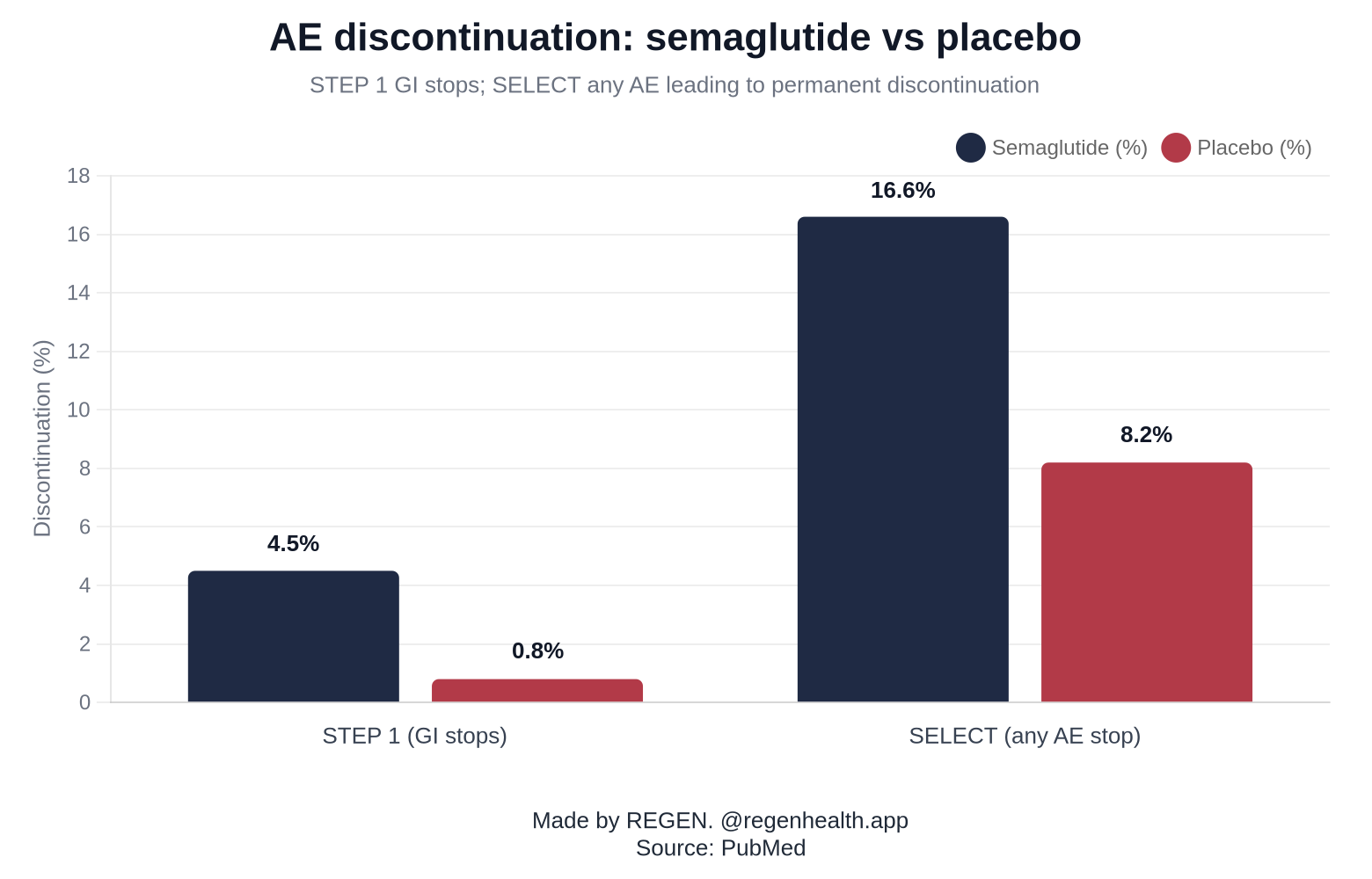
In randomized trials, Ozempic (semaglutide) side effects are mainly gastrointestinal. Discontinuation for adverse events ranged from 4.5% GI stops in STEP 1 to 16.6% permanent stops in SELECT, each figure tied to that trial's own population.
01 — Gastrointestinal events in clinical trials
In clinical trials, gastrointestinal symptoms are the primary adverse events reported with once-weekly semaglutide. In the STEP 1 trial of 1961 adults with overweight or obesity without diabetes, nausea and diarrhea were the most common adverse events; they were typically transient and mild-to-moderate and subsided with time.
In the STEP 8 trial of 338 adults with overweight or obesity without diabetes, gastrointestinal adverse events were reported by 84.1% of participants on weekly semaglutide and 82.7% on daily liraglutide. Those rates come from that head-to-head trial alone and are not mixed with other STEP or SELECT populations. Research pages for Semaglutide in the REGEN Library grade this kind of evidence by study design.
02 — Trial discontinuation rates across major studies
Treatment discontinuation due to adverse events differs by trial population. In the SELECT trial of 17,604 patients with preexisting cardiovascular disease and overweight or obesity without diabetes, adverse events leading to permanent discontinuation of the trial product occurred in 1461 patients (16.6%) with semaglutide and 718 patients (8.2%) with placebo.
In STEP 1, more participants discontinued treatment owing to gastrointestinal events with semaglutide than with placebo (59 of 1306, 4.5%, vs 5 of 655, 0.8%). That STEP 1 figure is specific to gastrointestinal discontinuations in adults without diabetes and is not compared here with SELECT's broader discontinuation endpoint.
03 — Diabetic retinopathy signals and glycemic drop
In the SUSTAIN-6 trial of 3297 patients with type 2 diabetes at high cardiovascular risk, rates of retinopathy complications (vitreous hemorrhage, blindness, or conditions requiring intravitreal treatment or photocoagulation) were significantly higher with semaglutide (hazard ratio 1.76; 95% CI 1.11 to 2.78). Fewer serious adverse events occurred with semaglutide, although more patients discontinued treatment because of adverse events, mainly gastrointestinal.
A post-hoc analysis of diabetic retinopathy across the SUSTAIN programme found no imbalance in retinopathy adverse events across SUSTAIN 1 to 5 and the Japanese trials. The majority of the SUSTAIN-6 retinopathy-complications signal was attributed to the magnitude and rapidity of HbA1c reduction in the first 16 weeks among patients who had pre-existing diabetic retinopathy, poor glycaemic control at baseline, and who were treated with insulin.
04 — Gallbladder and biliary disease findings
A systematic review and meta-analysis of 76 randomized trials involving 103,371 patients found that randomization to GLP-1 RA treatment was associated with increased risks of gallbladder or biliary diseases (RR, 1.37; 95% CI, 1.23-1.52); specifically, cholelithiasis (RR, 1.27; 95% CI, 1.10-1.47) and cholecystitis (RR, 1.36; 95% CI, 1.14-1.62). That analysis is class-level across GLP-1 receptor agonists, not Ozempic-only.
Use of GLP-1 RAs was also associated with increased risk of gallbladder or biliary diseases in trials for weight loss (n = 13; RR, 2.29; 95% CI, 1.64-3.18) and for type 2 diabetes or other diseases (n = 63; RR, 1.27; 95% CI, 1.14-1.43). Separately, in the SELECT safety analysis, gallbladder-related disorders were more frequent with semaglutide (2.8% vs 2.3%), mainly cholelithiasis (1.4% vs 1.1%), while cholecystitis proportions were similar (0.6% vs 0.6%).
05 — Serious adverse events in SELECT
In the SELECT safety analysis of 17,604 trial participants, the proportion of patients with serious adverse events was lower with semaglutide than placebo (33.4% vs 36.4%). Adverse events leading to discontinuation were higher with semaglutide (16.6% vs 8.2%), driven by gastrointestinal disorders (10.0% vs 2.0%).
Suicide and self-injury serious adverse events were low and balanced (0.11% in both groups) in that SELECT safety analysis. Semaglutide is FDA-approved in the United States for type 2 diabetes (Ozempic) and for chronic weight management (Wegovy); the SELECT population was adults with cardiovascular disease and overweight or obesity without diabetes. Related peptide pages in the Library, such as Tesamorelin, cover different mechanisms and different trial populations.
06 — How to read these trial numbers
Each figure above belongs to one trial or one meta-analysis and one defined population. STEP 1 and STEP 8 enrolled adults with overweight or obesity without diabetes; SUSTAIN-6 enrolled people with type 2 diabetes at high cardiovascular risk; SELECT enrolled people with preexisting cardiovascular disease and overweight or obesity without diabetes. Mixing discontinuation or adverse-event percentages across those cohorts would misstate the evidence.
For cited answers on what a specific paper actually measured, Regen AI shows the source inline. The REGEN Library collects compound pages with evidence grades, and our how we grade page explains how those grades are set.
FAQ
What are the most common Ozempic side effects in trials?
In STEP 1 (1961 adults without diabetes), nausea and diarrhea were the most common adverse events with once-weekly semaglutide; they were typically transient and mild-to-moderate.
How often did people stop semaglutide because of side effects?
In STEP 1, 4.5% discontinued for gastrointestinal events versus 0.8% on placebo. In SELECT, adverse events leading to permanent discontinuation occurred in 16.6% on semaglutide versus 8.2% on placebo.
Did trials report a retinopathy signal with semaglutide?
In SUSTAIN-6 (type 2 diabetes, high CV risk), retinopathy complications had a hazard ratio of 1.76 versus placebo. A post-hoc analysis attributed most of that signal to rapid early HbA1c drops in people with pre-existing retinopathy on insulin.
Is gallbladder disease linked to GLP-1 medicines?
A meta-analysis of 76 RCTs of GLP-1 receptor agonists (class-level) reported a relative risk of 1.37 for gallbladder or biliary diseases. In SELECT, gallbladder-related disorders were 2.8% with semaglutide versus 2.3% with placebo.